
Was Don Juan real? In the last thirty years of facilitating Carlos Castaneda’s work, many people have asked me this same question. My answers never seem satisfying, not even to myself. I never met Don Juan—I was five years old when he died.
Carlos Castaneda was real, though; his colleagues were real. How do I know that?
I saw them with my own eyes hundreds of times. I touched Taisha’s shoulders in a hug; I heard Castaneda’s voice numerous times, instructing me on how to prune trees, build a shoe shelf, and write; I smelled Florinda’s natural citrus scent as she passed by; and I tasted Kylie’s delicious food, including her homemade mashed potatoes.
This work, the practices we do, are about understanding ourselves as a unit of mind, body, and spirit that perceives the world around us through the senses, feelings, and experience. Our senses—the five mentioned above, and many others—reaffirm reality.
For example, proprioception and equilibrium—our awareness of the body moving through space in relation to the environment—increase as we practice energy passes. Awareness of internal body states—hunger, thirst, cold—our knowing of what we need from within (interoception)—is enhanced through recapitulation practices.
The information gathered by the senses is integrated into an experience, a cohesion we call reality. And reality has movement; it is always in motion, because we human animals develop our brains and perceptual possibilities through movement.
Today, the eyes have become the predominant sense in determining reality, to the point that they often override or ignore other senses and ways of knowing, such as intuition. Our modern eyes are fixed on phones and screens, strained by blue light and lack of nourishment, and locked into solid, unquestioned interpretations of reality, leaving little space for the unseen—for mystery to emerge. We fall into projections, trapped by past stories, unable to see what is actually in front of us.
A few weeks ago, I was on a short trip to a neighboring island. It was early morning, before sunrise, and I was sitting in an aisle seat. Next to me was a mother, and her daughter was by the window.
When the plane took off, the mother opened a children’s book about a baby crocodile going to the hospital with his parents. My breath tightened. The largest hospitals in Hawaii are located at our destination, and I immediately assumed the girl was going there for treatment. My head spun: “What is her illness?”
As the mother kept reading, turning the colorful pages about crocodile doctors and nurses caring for the baby, I noticed thick tears rolling down the girl’s cheeks. She began to sob. The mother paused, closed the book, and gestured for her to stop crying, with a hint of annoyance.
I wanted so badly to say something comforting. I wanted to tell her that I, too, had been sick when I was her age and that I made it through. But something in me paused.
Instead of projecting my story onto her, I closed my eyelids and gently moved my eyes up and down, returning to my breath and allowing the moment to be as it was—full of uncertainty, fear, sorrow, and frustration. It all existed within our shared bubble on row 12: mother, daughter, and I—a stranger sitting beside them.
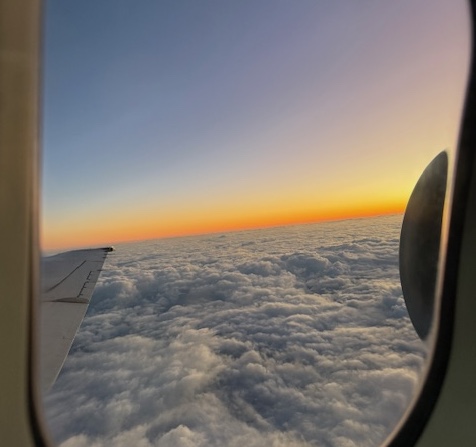
Several minutes passed. When I opened my eyes again, I saw the girl gazing at the sunrise through the window, over layers of white clouds. The entire plane had turned orange, yellow, and pink—like the colors of her book.
Suddenly, our tearful eyes met, now shining with awe. I smiled, and she smiled back: the entire universe became aware in that embrace, in that simple exchange.
In silence, I handed her my phone, and she took a picture of the new light. Our fingers touched, reaffirming reality. Her smile widened, revealing her two missing front teeth. Wonder, amazement, and reverence rose with the sun, holding within them our shared humanity—uncertainty, despair, and fear. I felt her mother’s shoulders soften as she embraced her daughter, and they both sighed.
Something unforgettable had taken place—we were meant to meet, to share that unexpected moment. We never exchanged words. In silence, I expressed my gratitude and my best intentions for her, wherever her path would lead.
Don Juan said the eyes perform two functions: looking and seeing. Looking is what we normally do—we look to recognize, to name, and to confirm what we already know. Seeing is different. It is without preconceptions.
Like the moment our eyes met, seeing is perceiving the essence of things—our presence beyond layers of conditioning. Seeing brings connection and a reaffirmation of our existence.
When we learn to see, nothing is ever the same again. I am not the same after this experience.
Every Sunday, at the end of our Path with Heart classes, I experience this same sense of connection, wonder, and amazement. For 17 years of facilitating these gatherings, it still happens: something beyond words, beyond rational understanding or even feelings of well-being. Something much bigger emerges, illuminating everything, and we remember who we are.
